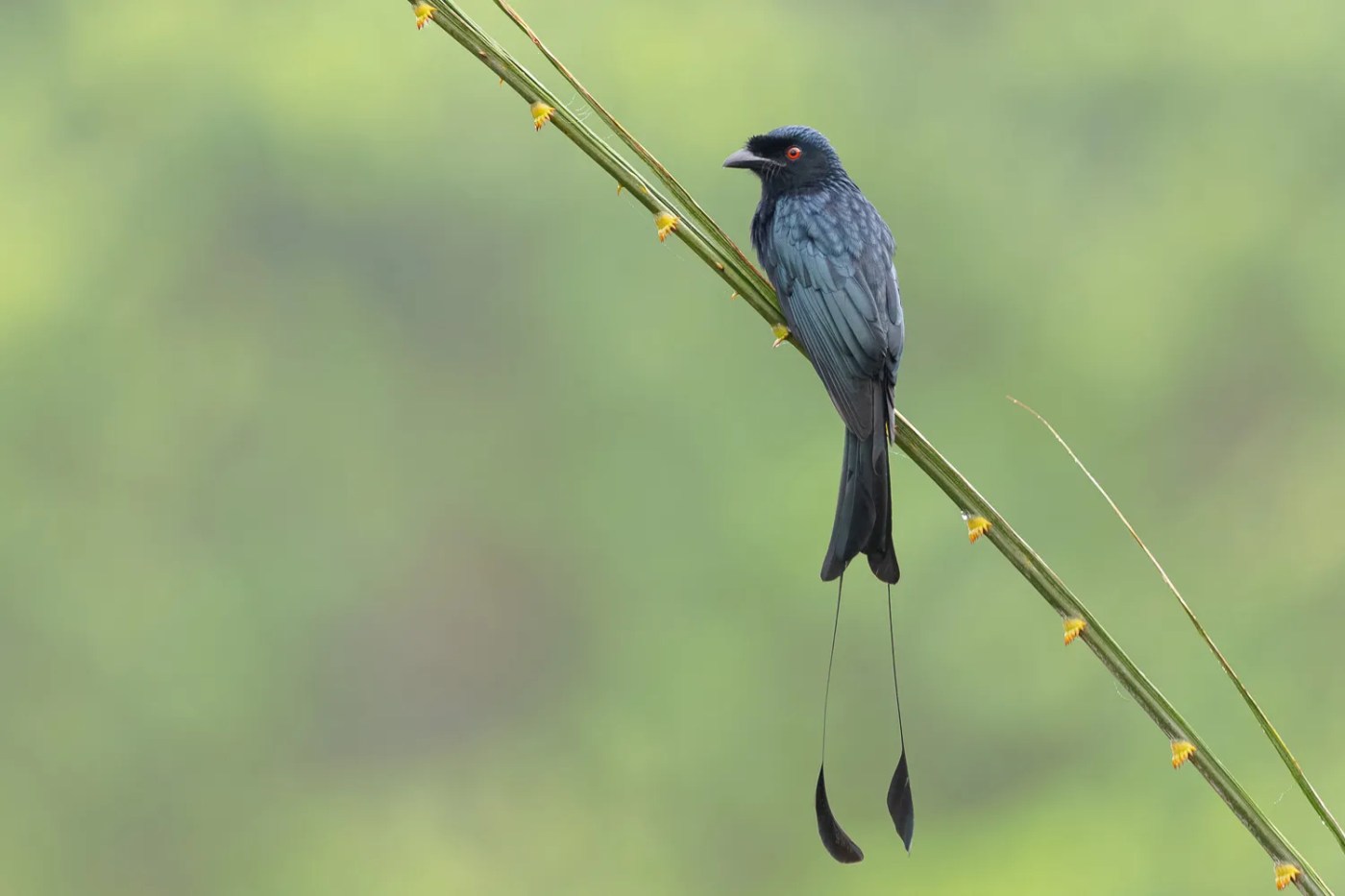
The Greater racket-tailed drongo is one of the easiest birds to describe visually.
If, of course, you are familiar with how the “regular’ Drongo looks.
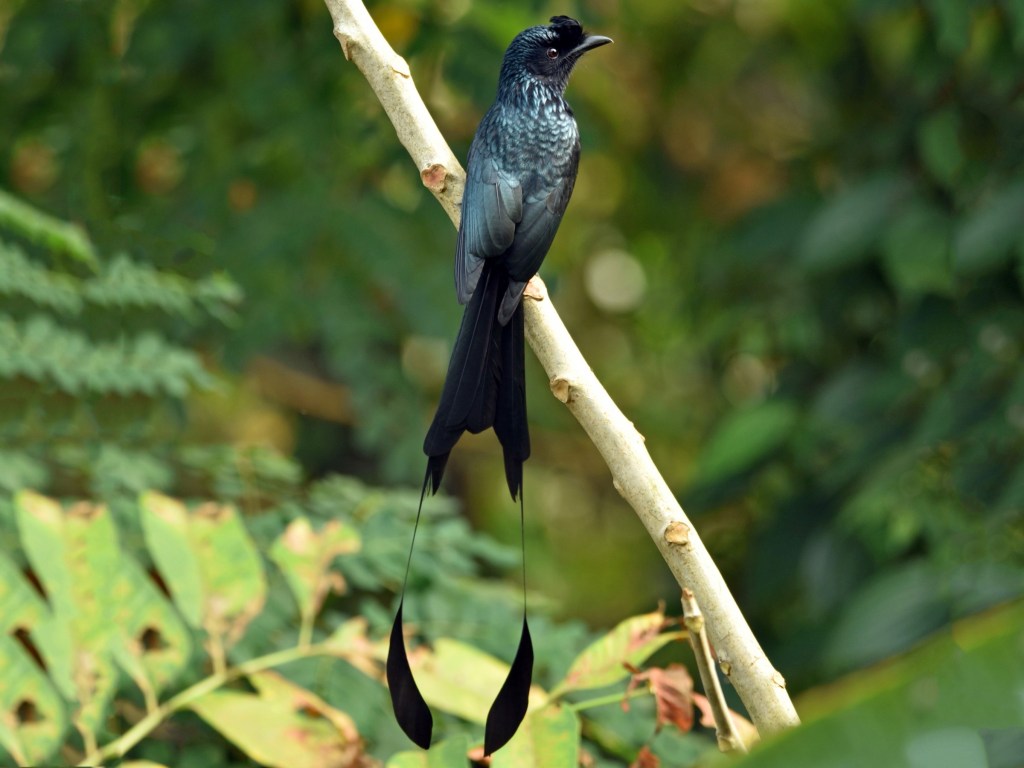
Picture the sleek black drongo with two long, twisted pendant-like extensions trailing from its tail. Its body is silky, glossy black. In our part of the world, black drongos are so common that a quick glimpse of the racket-tailed species might be dismissed as just another “regular” drongo.
Salim Ali famously describes the bird’s eponymous racket-tail as though the drongo were constantly being chased by two large black bees—a vivid image that captures its flight perfectly.
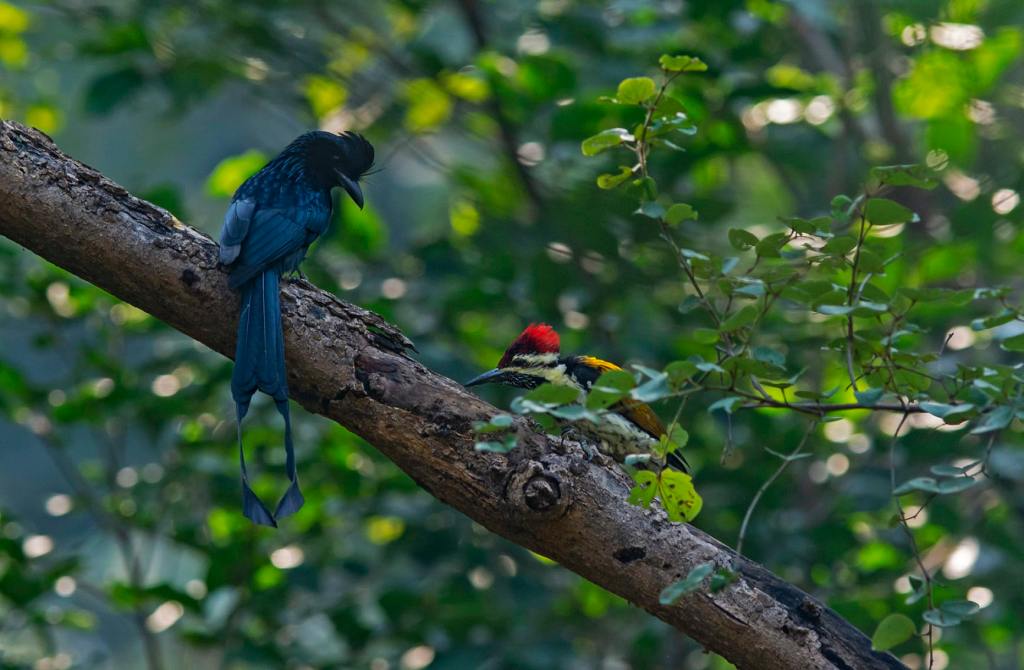
A couple of weeks ago, one drowsy afternoon, I encountered a lively flock of these noisy drongos. This is the birders’ equivalent of a scientist stumbling into a druids’ convention at the stonehenge at midnight. At the time, I thought the Drongos were overshadowed by flashier companions: Golden Orioles, Rufous Treepies, and a particularly busy Black-rumped Flameback woodpecker. Only later did I realise not only was I wrong, but that the gathering itself wasn’t random. There was a master puppeteer at work.
Describing the Greater Racket-tailed Drongo’s (GRTD?) appearance is straightforward. It’s their behaviour, however, that truly fascinates.
For years, I’ve championed the crow or raven as the intellectual heavyweight of the bird world to Mira. Whenever Mira and I spot a crow (a surprisingly rare sight in Bangalore these days), I remind her of the “plain” crow’s impressive IQ. I loved its understated, everyday status on most people’s “exotic bird list.” Crows, to me, were the Columbo of the avian realm.
(Quick detour: Columbo was one of my favourite shows—a dishevelled, rambling, seemingly forgetful lieutenant whose shabby exterior lulls suspects into complacency while his razor-sharp mind dismantles their alibis.)
The Greater Racket-tailed Drongo is a feathered Columbo. It hops through trees, gregarious amid flocks of more colourful birds, with those ungainly tail feathers trailing behind. As Edna Mode warns in “The Incredibles”: no capes! For a bird darting through underbrush after elusive insects or evading hawks, those long rackets seem like a liability.
Have we not seen enough movies in the 80s where the villain catches up with the heroine only because she is struggling to run through rice fields in a sari and trips and falls, much to the glee of the rapacious village goon or the licentious uncle?
Yet here the drongo plays the UNO reverse card.
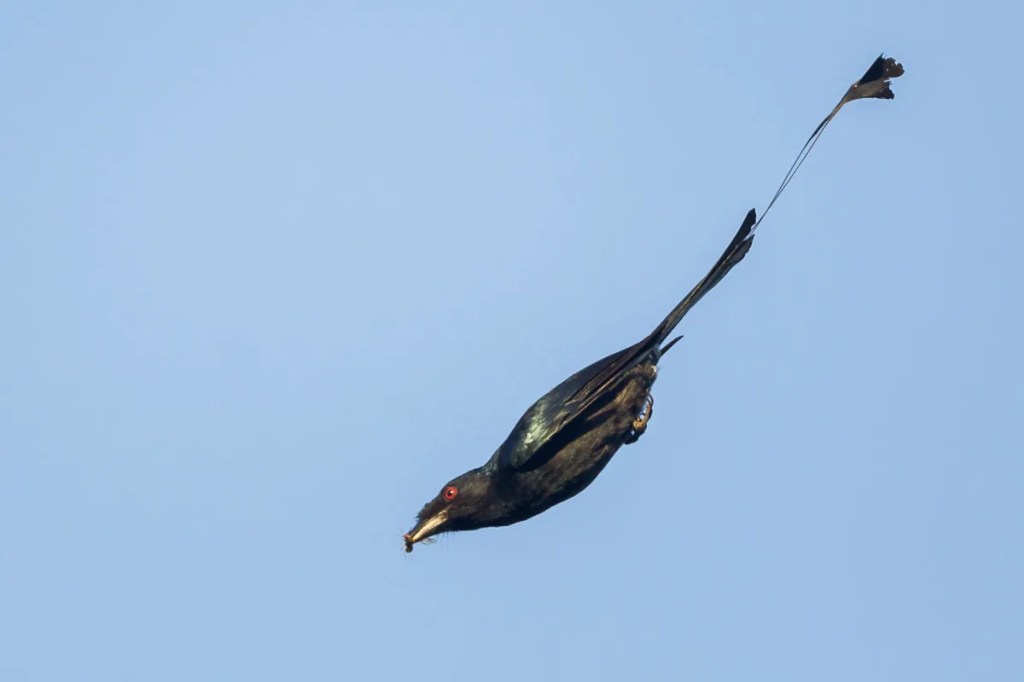
Far from being pushed around, it aggressively defends its airspace with fierce dives at intruders—larger birds included. In fact, it is very likely that other species might quietly be hoping the drongo never sheds its tail and acquires better manoeuvrability.
More impressively, the drongo runs a deviously sophisticated “protection racket.” It acts as a sentinel in mixed-species foraging groups, perching high to watch for danger while woodpeckers, babblers, and others feed below. That busy Black-rumped Flameback I saw? It likely benefited from the drongo’s vigilant lookout. In return, the drongo swoops in to snatch insects flushed out of the tree barks by the woodpecker’s drilling. The deal works because, as the old wisdom goes, for the woodpecker, it’s better to forage more at peace than to end up dead.
The woodpeckers aren’t fools either.
But the drongo’s cunning goes further. When genuine foragers are scarce, it actively recruits them—by mimicking their calls. Perched in a prime spot, it imitates the contact or alarm calls of nearby species, luring them into a mixed flock. Once the unwitting “muscle” arrives and starts digging, the drongo resumes its sentinel role while intermittently collecting its “fees” in grubs and insects.
That bustling avian ensemble I stumbled upon wasn’t a spontaneous picnic. It was a carefully orchestrated web of deception and mutual benefit, masterminded by the wily drongo.
Just when you think the drongo charges too high a price for its Kotwal duties, consider this: it mimics over 40 species of animals—including birds, frogs, mammals like macaques, and even insects. This master mimic can scare off predators, mob intruders, steal food from other birds (kleptoparasitism), assemble its own foraging parties, and even confuse amateur birdwatchers by sending them chasing phantom rarities.
I’ve never read Salim Ali’s works directly (though I’m sure they’re brilliant). I’ve enjoyed Simon Barnes and Tim Birkhead’s excellent storytelling about the natural world. However, for this piece, my main source was closer to home. Greater Racket-tailed Drongo expert from the Biligiri Rangan Hills, Dr. Samira Agnihotri, shared through the wonderful Roundglass Sustain project. I’ve merely added a few personal flourishes.
As always, I take refuge in the bird itself. We are all mimics—some masters, some apprentices.




 The Reluctant Book Worm
Leave a comment