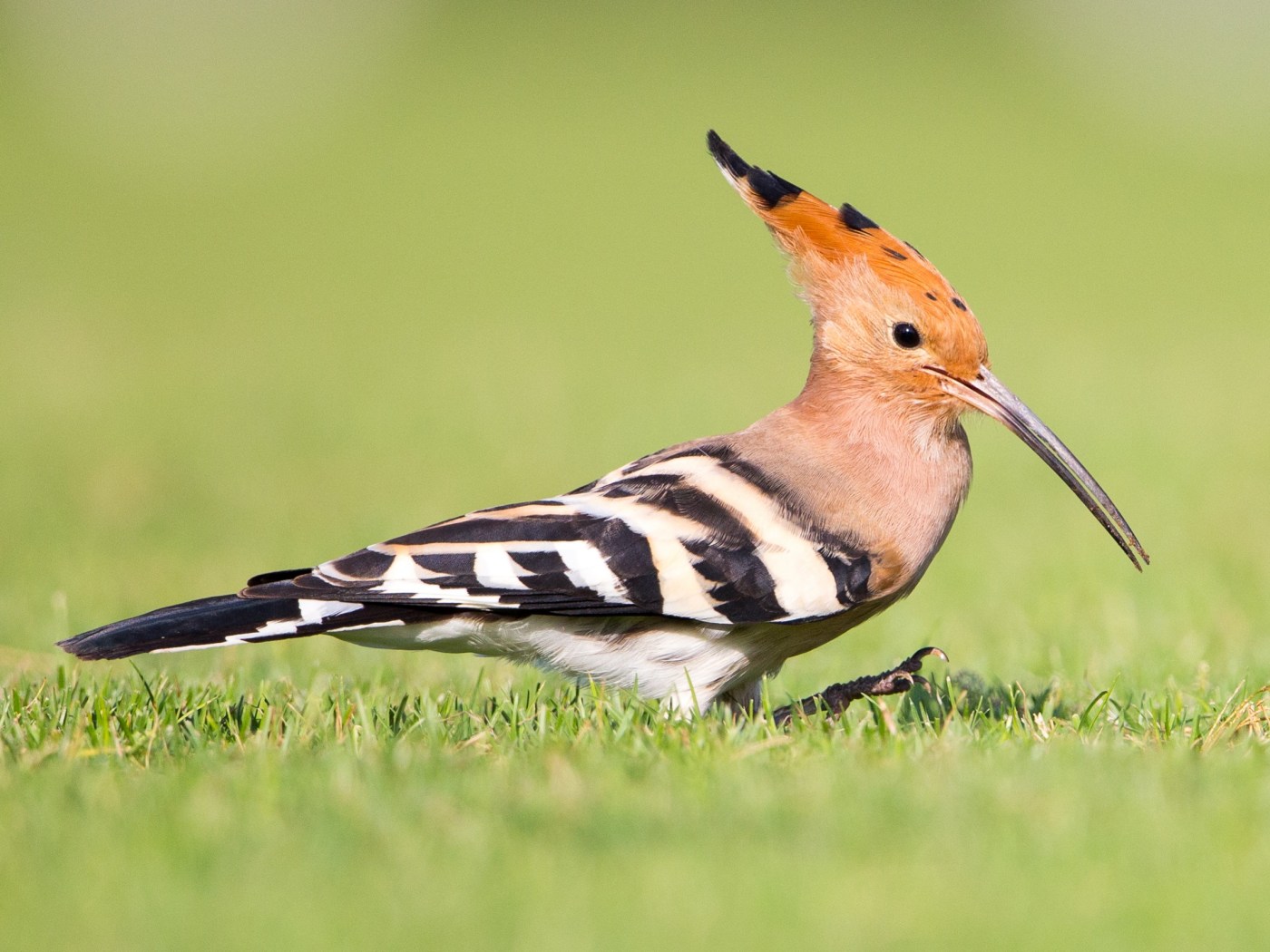
The Eurasian Hoopoe is my Proustian madeleine.
I do not see enough Hoopoes nowadays, that whenever I spot one, I am taken back to childhood sunny gardens, chasing them away on aimless afternoons. Their fleeting presence evokes a warm nostalgia, stirring an innocent joy that’s hard to recapture.
Mike Unwin, in his evocative book “Around the World in 80 Birds,” writes of the Hoopoe:
Once spotted on its high perch, this thrush-sized songster is unmistakable. The combination of long, down-curved bill and folded crest gives its head a unique pickaxe profile. Then, when it takes off in a floppy-winged, moth-like flight, it bursts into colour, the warm cinnamon body set off by vivid black-and-white stripes across wings and tail, and the crest flaring into an impressive fan as it alights. A real show-stopper.
Whenever I get stuck on what to write—which is often—I go back to Unwin. I pick at his work, trying to recreate the simple elegance of his prose. Mostly, I fail, but his work reminds me that one does not have to be fancy to write well. There is beauty in structure and execution.
In that way, writing is mostly like architecture.
Gaudí’s flamboyant designs or Bawa’s tropical harmony captivate instantly as much as the understated Kyo-Machiya townhouses or the terracotta-tiled roofs of the Canara coast.
They all evoke a quiet sense of balance.
Simon Barnes is another writer whose lucid writing about nature is erudite and light. There is wisdom in his words. A zen-like quality that only focuses on what the world means to him, without the burden of how the words are strung for the reader.
Of course, that may not be the case, and they could all very well be deliberately chiselled to give an air of mastery of language with the right hint of humility. Whatever it may be, I love the end result.
Hoopoes—they are like old friends. Whenever I spot a Hoopoe, I find some inaccessible part of my heart activated with warm fuzziness. Nameless comfort and nostalgia surge through me in waves. Yet, like the dark forests of fairy tales, that emotional path closes when I try to chase it when alone.
Only the Hoopoes—those cinnamon-hued, crest-flaring aerial drill hammers—seem to hold the key.


Unwin associates the Hoopoe with Europe, but I know them from the Asian heartlands, particularly Tamil Nadu and Kerala, where they’re called Kondalathi in Tamil and Uppuppan in Malayalam. These resident birds blend seamlessly into India’s landscapes. They’ve graced ancient Greek myths, biblical tales (carrying messages between Queen Sheba and Solomon), and Egyptian hieroglyphs. In the Levant, they’re migratory, heralding spring, whereas in India, they’re earthy locals.
Last month, I saw a Hoopoe flit between the majestic banyan trees of Pattadakkal. I was sitting on the banks of the superbly unassuming (given its significance in Indian History) Malaprabha River. Millennia-old temple complexes sprawled behind me, with tourists gaping in awe at the grand undertakings of ancient Chalukya kings.
First, I noticed a Greater Flameback hopping and tapping a branch for snacks. The glorious red back made it easy for my eyes to lazily follow the bird as it worked its way up the branch with its rhythmic, nervous tapping. Just as it flew away (or maybe because of the arrival of the newcomer), a Hoopoe landed on the branch.
I hadn’t seen Unwin or Barnes weave the Hoopoe’s presence in India into their observations. Here I was trying to redeem it in my own small way.
The bird stared past me with a cocked head, with the indifferent contempt of a species not meant to be reduced to content fodder for fleeting writers.
The Hoopoe had larger timelines to chase, grander odes to pose for, and juicier grubs to savour.
hoop-ooop-ooop. A flutter of wings.
I was alone with the river and the tree again.




 The Reluctant Book Worm
Leave a comment