
In the eminently watchable movie The Mummy, dashing adventurers Rick (Brendan Fraser) and Evelyn (Rachel Weisz) go in search of the mythical Egyptian City of the Dead, Hamunaptra. They journey across the arid Sahara, reaching the location, but they still cannot locate the town.
“It is here,” reassures Rick, even as the posse waits in disbelief, staring at the yellow sand dunes stretching out for miles in front of them. Then slowly, the sun rises. The mirage shimmers, and shadows emerge, revealing a magnificent city right before their eyes, where nothing seemed to exist just moments earlier.
Thus begins a madcap adventure. One of the best movies starring the fantastically charismatic Brendan Fraser.
Visiting Itagi was exactly like that.
I had come across faint mentions of this sublime temple in the maps. But not many folks seem to have visited it. The Indian government listed it as an important sight to see, but empirical wisdom dictates that there is less truth in the Indian Government’s tourist advertisements than in booking.com’s “photos of the property by the owner”.
I set out. Anyways, Lakkundi lay nearby.
Where the map asked me to move away from the national highway, there was a washed-out sign. A pale yellow, almost white sign with no discernible markings. I am familiar with these signs. They are the remains of a well-conceived but poorly executed tourism development plan by the government. All that’s left of that project are such washed-out, unreadable markers.
Unreadable. But clear indications that a monument was nearby.
Then, without notice, the Itagi Mahadeva Temple revealed itself, rising out of the dust and sun at the last conceivable moment.
My own Hamunaptra.

The unassuming approach to the Itagi Mahadeva Temple
This western Chalukya temple was built around 1112 CE. This was built just before the Airavateshwara Temple, by the Chola King RajaRaja II, which was built around 1150.
It suddenly seems to make sense, and I realized how I understand history. It was through my physical senses and not through scrolls.
The departure from the massive, almost cosmic proportions of the Brihadeeshvara Temple at Tanjavur and Gangai Konda Cholapuram now made sense. The Hoysala architecture, replete with soapstone carvings, traded in size for intricacy. The Cholas were working with Granite. An impossibly tough material, and so they went big. They used the stone to assemble spaces.
The Chalukyas, meanwhile, had soapstone at their disposal. Why build out of granite when you can carve out of soapstone? It makes perfect sense.
I guess that’s what travel does to you. It reassures one that answers exist. We might not be able to unearth everything that niggles us. Heck, we might not even realise it was an unscratched itch.
But standing there, gazing at the Itagi Mahadeva temple, built by the Western Chalukyas, I found a plausible answer to a doubt I didn’t even know I had after the Tanjavur trip. The small gears slipped into place, and I was better off for it. Like accidentally finding a better-fitting shoe than the one I was walking in.
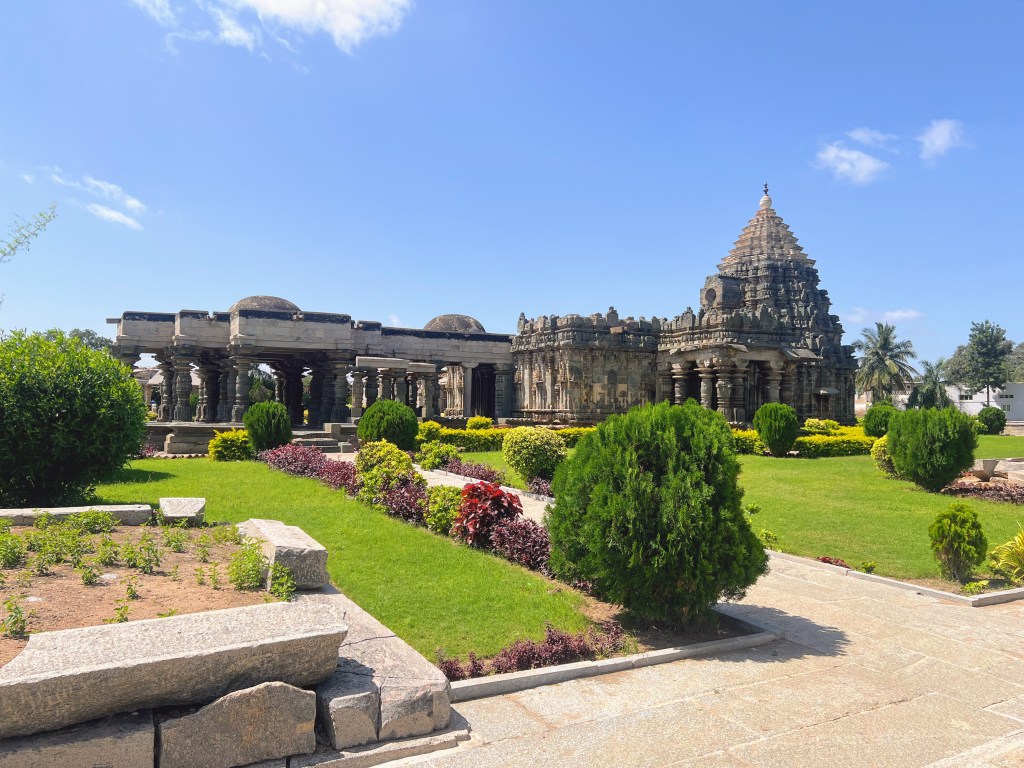
The immaculately maintained lawns at Itagi by the Archeological Survey of India
The temple is extremely well-maintained. Clearly, a benevolent force was at work.
Who could be directing such meticulous restoration of the stones? Someone evidently is taking immense pride in maintaining these immaculate lawns in the middle of nowhere.
“It is the ASI. They are planning to build this up as a part of a heritage monument trail,” the poojari explained to me. Generally, such grand statements make me smirk. Phrases like “build this up, spruce this up” by any government body rile me, because I have never seen history preserved through such projects. They are only concretised by contractors.
But this seems different. I am happy and thankful that I am wrong about such assumptions.
The Itagi Mahadeva Temple is truly magnificent. Ornate pillars, drenched with tasteful embellishments, ooze from ceiling to floor. Who are these artisans? Where have these tastes and passions evaporated today among the teeming billion that is modern India?

The stupendously ornate Pillars of Itagi
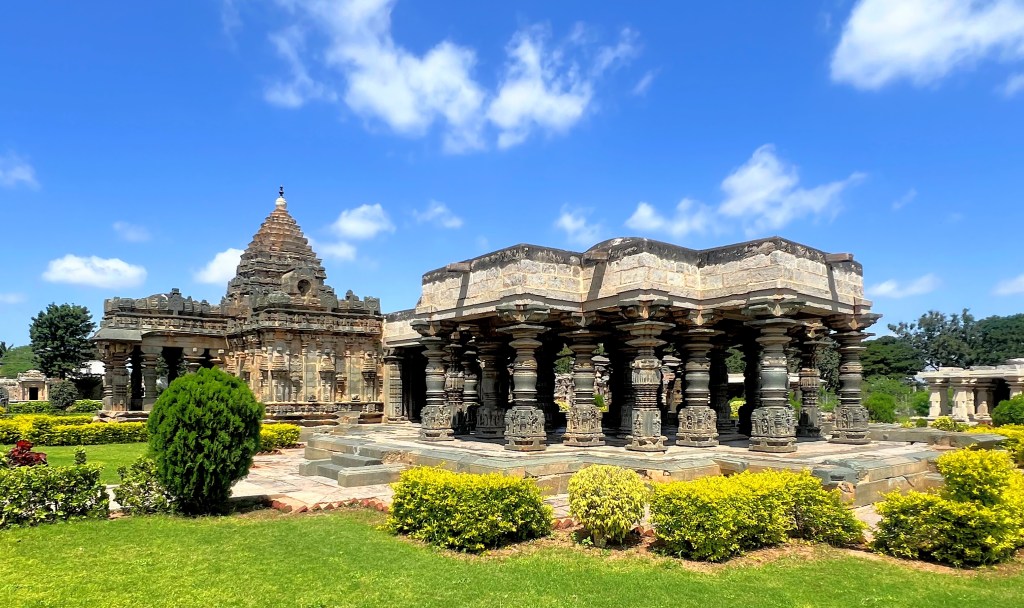
Poetry in Stone
The pillars are churned out in meticulous proportions. They are then carved with infinite precision.
The Chalukyas could carve out a universe from stone.
Is all this worth a 2-hour drive through non-existent roads from Badami? I’d do it again without a second thought.
Staring at stones is the closest I feel to transporting myself to olden times. To immerse myself in thoughts that comfort me about my current times. Here is a millennium-old structure, half-eroded, yet it still surpasses our current infrastructure projects in grandeur and aesthetics. This is the antithesis of how I feel when reading my morning newspaper, gnashing my teeth and fuming at the funds allocated to the newest tunnel road by crooks masquerading as leaders.
Mahadeva, a commander, a dandanayaka, in the army of a Western Chalukya King, commissioned this masterpiece. After poring over some history of our subcontinent, I am content with this level of coarse understanding.
Kings seem to come and go. Repetitive names in dynastic processions. Conquests and killings and grand projects. I am too old to keep track of the details.
For now, all I retain is that the Western Chalukyas were contemporaries of the Cholas. Both built impressive temples, albeit in differing styles. Sanskrit appears to have been the court language, while Kannada was the language of the masses.
12th Century Kannada architecture = Ornate Soapstone.
12th Century Tamil Architecture = Hewn from Granite.
I still do not know how the Chalukyas differ from the Hoysalas. Both seem to have overlapping architectural credits. Belur, Halebid, and Somnathpur are all attributed to both the Hoyasala and Chalukya dynasties in turn.
For now, I am reducing it to the Chalukyas. Why? Because I am no expert, and shedding the weight of precision makes life lighter.
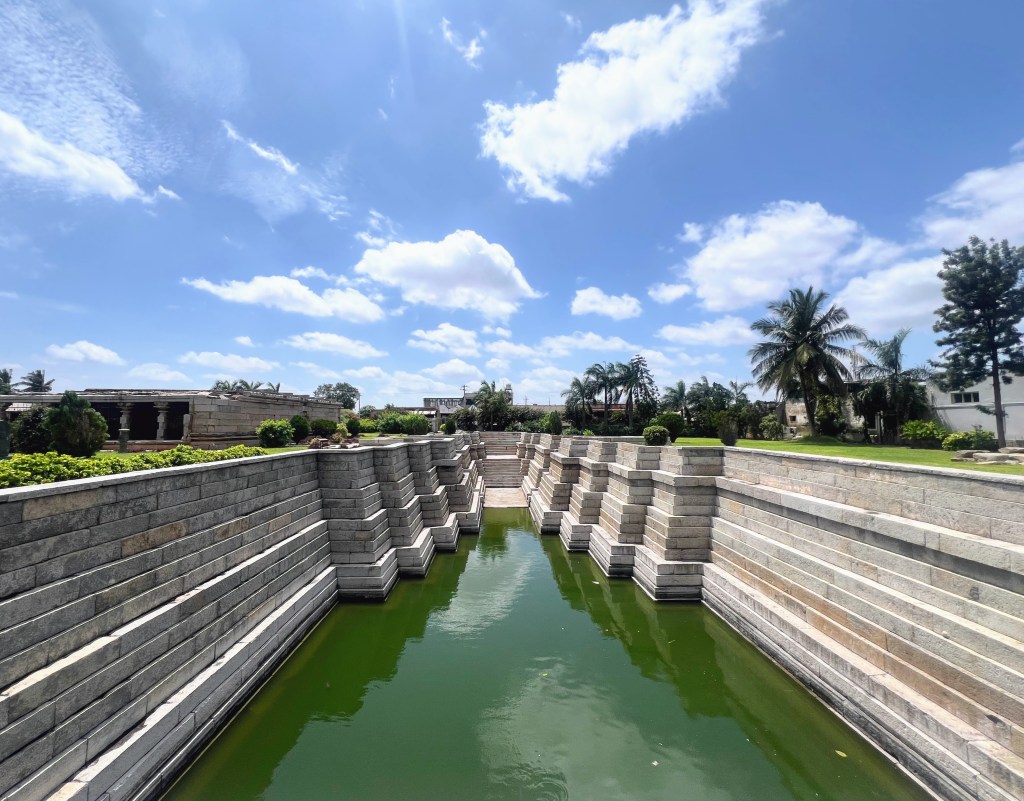
The stepwell at Itagi




 The Reluctant Book Worm
Leave a comment