
Sithannavasal was not on my list when I started out from Mysore. My plan had been to spend as much time as possible in the three Chola Temples at Tanjavur.
Mira wanted to spend time at the farm with her grandparents. Neha was travelling for business.
I realised I had 4 days to myself.
Usually, I would have headed back home to Bangalore and fallen into my routine. As a creature of habit, I derive great pleasure and comfort from routine. But ever since I took a break from work, my perspective on my time on earth has expanded.
I want to make time count.
I read a lot more intentionally today. I want to savour ideas, experiences, and tales better. I have slowed down to do fewer things and spend more time doing them better.
That’s how I ended up driving to Tanjavur via Coimbatore. At Tanjavur, I got a message from a friend who had seen some of my pictures. “Go to Sithannavasal,” Mr. Karthik commanded.
I had to look up the place. Sithannavasal was a 75-kilometer drive.
The next morning, I started out early, after a meal of onion dosa and coffee.
We sweat life a little too much. Bangalore does not have onion dosas. If you order one, the Bangalorean shamelessly clatters a plate of onion uthappam (the Bangalore version of which is also nothing to write home about) in front of you.
Onion dosas, with their slightly caramelized onion bits, stuffed between a folded dosa, have attained a cult status in my palate because I don’t travel to Tamil Nadu often. As I turned right near Pudukkottai, I wondered why and how the mighty Bangalore had such subpar indigenous food. Rameshwaram Cafe is the latest entrant among pretenders crowding out local flavor profiles.
Loud flavours with zero love.
By around 9:00, Sithannavasal loomed into view. Behind palm trees and paddy fields, the granite rock rested, starting to bake in the sun.
Jains – Sidhars, or Samanars – always chose rocky outcrops for their habitation.
I grew up in the 1980s and 1990s near Madurai, just 2 Kilometers from home were the rock-cut Jain caves at Keelakkuyilkudi. They date back to at least the early 5th Century CE. I still rue that I haven’t visited them even once.

Maybe that is one of the reasons why I made this trip.
Isn’t everyone’s life a series of decisions that are personally driven? It is not that tough to understand humans, if—and this is a big if—if you have an understanding of their background.
The solo drive was a gentle immersion into a childhood rural landscape, with fields stretching wide under a sky that felt impossibly vast. As I approached the 70-meter hillock that defines Sittanavasal, I could already sense the weight of centuries, mingling with a nostalgic longing for home that lingered in the air, a quiet whisper of stories from a time past.
I was glad I did this trip alone. Even though Neha and Mira have seen me as a partner and father, they have never seen anything of my pre-marriage version. Such is modern living that I have never interacted with my wife and kid in my two most revealing languages, Tamil and Malayalam.
Sittanavasal, derived from the Tamil “Sit-tan-na-va-yil”, is a Jain cave complex dating back to the 2nd century BCE, and was a flourishing center of Jainism from the 1st century BCE to the 10th century CE.
Jainism, with its emphasis on non-violence and asceticism, thrived in Tamil Nadu during the Sangam period, as evidenced by Tamil-Brahmi inscriptions found here and in places like Madurai and Kazhugumalai. These inscriptions, some from the 1st century BCE, are among the oldest in South India, a testament to the deep roots of Jainism in Tamil culture.
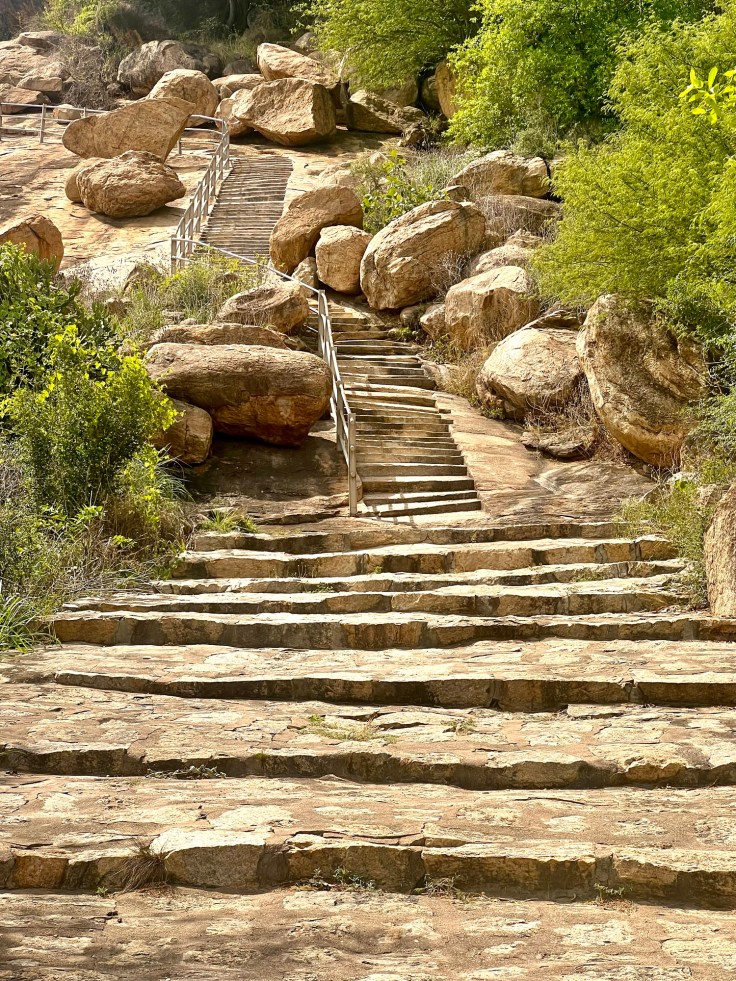
“Sir, please take a bottle of water,” the guard cautioned as I stood contemplating the climb.
The Caves: 2000 years. 300 steps.
Me: 44 years. 95 kgs.
If I die, I die. After all, it was a mausoleum refuge of sorts.
Luckily, I made it to the top with a few rests. The initial few steps are the hardest for the ego. Once you have subdued your ego, every step is a resting point.
The dry rock was still not too hot. There was a cool breeze blowing. These steps were cut by the Samanars. From here, we get a bird’s-eye view of the surroundings.

Tamil lands were sanctuaries when the Buddhists and Jains were persecuted in the north of India. A considerable percentage of classic Tamil literature is Jain literature. Cilappatikaram, Civaka Cintamani, Valayapathi, and the immensely popular Thirukkural are all attributed to Jains.
I reminded myself not to reduce Jains to paneer and bad food. In fact, Sri Arya Bhavan at Tanjavur had a remarkable spread of vegetarian food. A full plate of meals is all one needs for lunch.
It must have been the heat. I was sweating profusely, and my body was warmed up from all the climbing. The rock stretched all the way and around a bend. After a couple of sips of water, I resumed the climb.

Once I rounded the corner of the rock, the cliff began to bald. Here, there is just stone.
The approach through the powerful bare rock face humbles me. The surface is hot and will only get hotter. The cave and fissures in the rock seem cool and, further in, damp. I could see clusters of bats hanging undisturbed, swaying like bunches of furry fruits. I felt a shiver down my spine.
Bats aren’t my favorite animals.
They prefer the dark. They hang upside down, at odds with other mammals and birds. I cannot imagine ancient humans cohabiting with these creatures of the dark, in an era when light was a precious commodity.

The Samanars are minimalists. The rock caves are evidence of it. The stone “beds” are rectangular, and, as with the irony of time, they are the most durable. Protected from the ravages of nature, the contemplative Samanars’ modest habitation has endured longer than whole civilisations.
“I was in Singapore, sir, in Bedok,” said Murugesan, the guard.
We chatted for a bit.
“I am happy here, sir. In Singapore, I caught an illness and thought I was about to die. I made a call to come back. Luckily, I got a posting right here.”
Murugesan was born, raised, and lives just 4 kilometers from the cave.
Whenever he has security detail, in the morning, he ascends the rocks, spends his time alone at the top of this hill, and descends at dusk.
He was not on the phone when I approached the caves.
Sramanar No.2
On the way back, I stood near the edge of the cliff (there was a natural balustrade of sorts, so it wasn’t as unsafe as it sounds), surveying the land below. Sounds carried far in these open lands. I could hear the chugging of an old classic Royal Enfield as it made its way down the road 3 kilometers away.
Down in the fields, I could see the white specks of Cattle Egrets. I recognise the calls of Peacocks, Red Wattled Lapwings, Greater Coucals, Drongos, and the Asian Koel. How much empty vistas fill with character when you take the effort to study them!
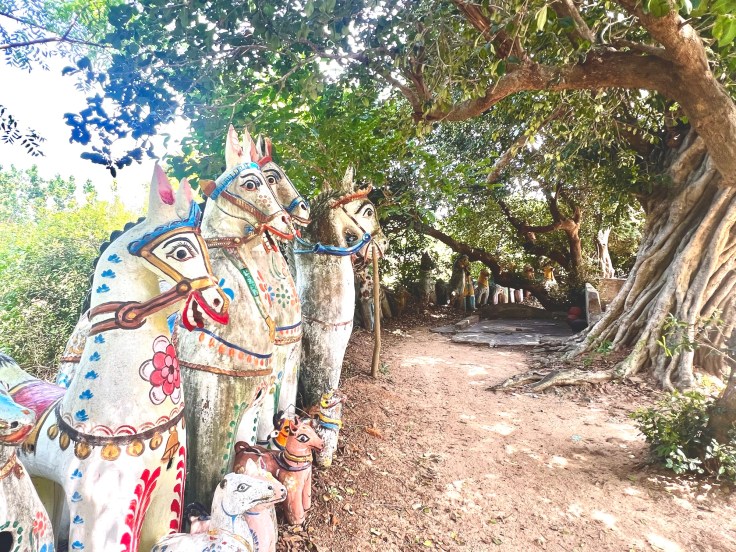
At the foot of the hills was a small Ayyanar temple. Terracotta horses were lined up under the leafy banyan tree. Pre-Vedic sentinels. Offerings of local potters and clay workers.

As the sun was climbing higher, I rested a bit here. It was an eerie place even though it was broad daylight. Ayyanar temples always remind me of the series Vidaadhu Karuppu. Sithannavasal had a similar ring to it. Ayyanars are vengeful if crossed. Exacting in their blood-thirsty demands of sacrifices and fierce protectors of their territory when pleased.
The best trips I have had, the kind I look back on fondly, are those where I get to sit for hours in a place. Evenings sitting on the banks of the majestic Mekong River in Laos, watching Buddhist monks returning to their monasteries after their Bhikshas. Sitting atop cliffs in the Acadia parks, staring out onto the blue Atlantic. Staring at rain-soaked trees in Singapore’s intersections.
Or maybe I like them because I get to sit and admire them without justification. Sitting still and observing is healing.


The cave temple, Arivar Koil, a little further on, is attributed to the Pallava king Mahendravarman I before his conversion to Shaivism, with later renovations by Pandya kings like Maran Sendan or Arikesari Maravarman around the 7th century.
Climbing the few hundred steps to the Arivar Koil was easier than climbing up to the rock beds. The steps, carved into the rock, were smooth and slightly slippery. At one point, I noticed a small snake slithering away to the side as footsteps approached. Olappambu sir, smiled a fellow huffer. “Won’t do anything.”

The security guard watched as a couple of other people and I struggled up the steps. After all of us had made it to the top and sufficiently rested, he ushered us closer.
“I am no historian, but if you are interested, I can walk you through this place.”
I have never come across a more well-researched exposition, delivered fluently and animatedly, in my life. Sithannavasal came alive under his passionate and encyclopedic knowledge.
As I entered the cave temple, I was struck by its simplicity—a rectangular mandapam with two hexagonal pillars and a small sanctum housing a serene image of Parshvanath, the 23rd Tirthankara, with a five-hooded serpent above his head.
But it was the ceiling that stole my breath. The fresco-secco paintings, created between the 4th and 6th centuries, shimmered faintly in the dim light, their vegetable and mineral dyes—ochre, lime, lamp black, and terre verte—still vibrant despite centuries of wear. The most striking mural depicted a lotus pond, teeming with fish, geese (Andril Paravais are Ibises, though according to Google), buffaloes, and elephants, with bhavyas collecting lotuses, a realm on the path to Jain enlightenment. The delicate lines and lyrical flow of the artwork felt like a window into a divine world. Vandalism and time have faded much of these masterpieces, though the Archaeological Survey of India’s efforts to preserve them are evident.
They were genuinely some of the most exquisite artistry I have seen.

Standing in the inner sanctum, the guard pointed out the cave’s unique acoustics. When he softly uttered “Om,” a gentle hum echoed back, as if the rock itself was responding. The security explained that only specific frequencies resonate here, a phenomenon that felt almost mystical. It was easy to imagine Jain monks chanting here, their voices blending with the stone in a meditative symphony. The paintings and the cave’s design hinted at a possible earlier life as a Saivite shrine, with elements like the lotus medallion and the aavudayar pedestal suggesting a layered history of religious transformation, a common practice in ancient Tamil Nadu.
“Is this all?” a lady asks, cackling.
The security guard smiled serenely and said, “This is all there is, ma”.
Samanar No. 1.
Standing there, I felt a quiet reverence for the unseen monks’ discipline, a stark contrast to the modern world’s clamor.
As I left Sittanavasal, the sun was dipping low, casting a golden glow over the hill. The experience felt like a pilgrimage, not just to a place, but to a deeper understanding of Tamil Nadu’s past.




 The Reluctant Book Worm
Leave a comment