
We had planned on a trip to Thailand last year, 2024. Saturdays and Sundays were spent researching the place. Every weekend, we’d go to Thirdwave on Sarjapur Road to spend some time looking up the places we wanted to go.
This one time, Mira jumped up excitedly. “Appa, check this out,” and turned the laptop around, and I peered into it myopically to see what it was that was so exciting. It was the Jim Thompson house.
A search for “how do the interiors of Thai Houses look?” led her to this serendipitous discovery. We had to put it on our to-visit list.
If you’re ever in Bangkok, this passionate ode to Thai architecture’s history and culture is unmissable.
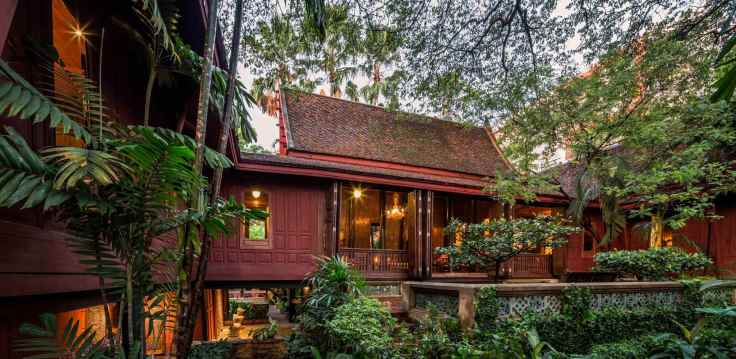
Nestled in the heart of Bangkok, Thailand, the Jim Thompson House stands as a cultural gem, weaving together the elegance of traditional Thai architecture, the lush beauty of its tropical gardens, and the enigmatic legacy of its creator, James Harrison Wilson Thompson. This museum, once the residence of the American entrepreneur known as the “Thai Silk King,” is a testament to his passion for Thai art, silk, and culture. Spanning approximately half an acre along the Saen Saep klong (canal), the house is a harmonious blend of history, aesthetics, and mystery.
It was early on a sweltering hot day that we visited the Jim Thompson House.
Despite the occasional rains and the considerably cooler temperatures in the southern parts of the country, Bangkok was still sweltering in all its tropical glory.
Constructed in 1958–1959, the Jim Thompson House is a masterpiece of traditional Thai architecture, reflecting Thompson’s deep appreciation for the country’s cultural heritage. The house is not a single structure but a complex of six traditional teakwood houses, meticulously sourced from various parts of Thailand, primarily Ayutthaya and the Bangkrua silk-weaving community across the klong. These structures, some dating back to the 19th century, were dismantled, transported, and reassembled under Thompson’s supervision, with the aid of skilled carpenters from Ayutthaya. The result is a cohesive residence that embodies the grace and functionality of Thai design.

The house was elevated on teak pillars, a hallmark of traditional Thai architecture designed to protect against flooding and pests while promoting ventilation in Thailand’s humid climate. The inward-leaning walls and columns create an illusion of height and elegance, while the steeply pitched roofs, adorned with green Chinese tiles, deflect heavy monsoon rains. The largest structure, originally a weaver’s house from Bangkrua and now serving as the living room, is a focal point of the complex, showcasing Thompson’s ability to blend disparate elements into a unified whole.
The whole house is a testament to how much Thompson valued and loved Thai culture. For example, every room had a raised doorstep to prevent ghosts from entering the house— a lore that Thais believe in.
Inside, the house is a living museum, adorned with Thompson’s extensive collection of Southeast Asian art. Visitors encounter Chinese blue-and-white Ming porcelain, Cambodian carvings, Burmese statues, and Thai stone images, all meticulously arranged to complement the teak interiors. The absence of nails in the construction, a nod to traditional techniques, enhances the authenticity of the space. The open, airy layout, with dark teak walls and silk-draped furnishings, creates an intimate yet opulent atmosphere, inviting guests to step into Thailand’s past.
The Lush Oasis of the Garden
Surrounding the house is a tropical garden, often described by Thompson himself as a “jungle” for its dense, vibrant foliage. This lush oasis, with towering palms, golden bamboos, and cascading creepers, provides a serene contrast to Bangkok’s bustling urban landscape. The garden’s design remains largely unchanged since Thompson’s time, preserving his vision of a tranquil retreat. Ponds dotted with lotus flowers and shaded pathways enhance the sense of escape, making it a haven for visitors and a critical element of the house’s charm.

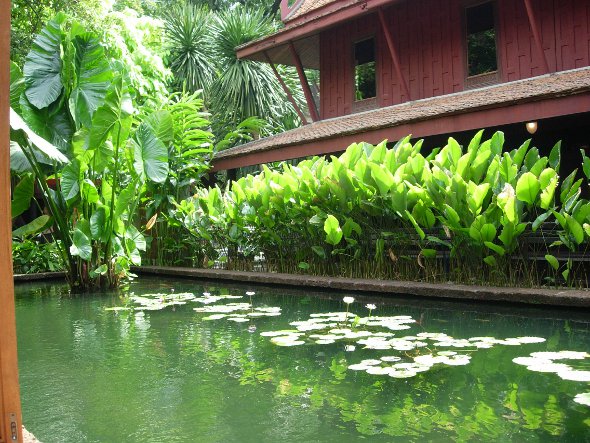
The landscaping reflects Thompson’s attention to detail, with every plant chosen to harmonize with the traditional Thai aesthetic. This verdant setting not only enhances the house’s beauty but also underscores Thompson’s commitment to preserving Thailand’s natural and cultural heritage.
The Klong: A Lifeline of Culture and Commerce
The Saen Saep klong, running parallel to the Jim Thompson House, is more than a scenic feature; it is a vital artery of Bangkok’s history and Thompson’s silk empire. In the 1950s, klongs were the city’s primary transportation routes, bustling with boats carrying goods and people. Thompson strategically chose this location across from the Bangkrua silk-weaving community, ensuring easy access to the weavers who produced his fabrics. The klong facilitated the transport of silk and antiques, linking Thompson’s home to the broader network of Thai commerce.

The klong also embodies the nostalgic charm of old Bangkok, which captivated Thompson. Wooden houses along its banks, shaded by overhanging trees, evoke a slower, simpler era. Today, the klong remains a working waterway, with boats ferrying passengers and goods, though its role has diminished with the rise of modern infrastructure. For visitors, the klong adds an authentic dimension to the Jim Thompson House experience, connecting the museum to the living traditions of Thailand.
Jim Thompson’s Love for Silk and the Industry He Built
Jim Thompson’s legacy is inseparable from his transformative impact on the Thai silk industry. Born in Delaware in 1906, Thompson was an architect, OSS officer, and art collector before arriving in Thailand in 1946. After World War II, he saw the untapped potential of Thai silk, a craft that had declined due to cheaper Western imports and outdated production methods. In 1948, he founded the Thai Silk Company Limited, with an initial investment that, while modest, grew into a multimillion-dollar enterprise.
Thompson’s innovations were both technical and aesthetic. He improved weaving and dyeing processes, introducing vibrant jewel tones and bold color combinations that became synonymous with Thai silk. By allowing rural women to weave from home, he empowered thousands of families, combining economic development with cultural preservation. His breakthrough came in 1951 when his silks were used in the Broadway production of The King and I, catapulting Thai silk onto the global stage. Fashion houses in New York and Europe soon clamored for his fabrics, cementing his reputation as the “Thai Silk King”.
Beyond commerce, Thompson’s love for silk was deeply personal. He was often seen inspecting silk pieces at the klong’s edge or displaying them in his home, where they adorned furnishings and complemented his art collection. His commitment to quality and authenticity earned him the Order of the White Elephant, a prestigious Thai honor, and his company continues to thrive, with stores in Bangkok’s major shopping centers and a global online presence.
The Mysterious Demise of Jim Thompson
The story of Jim Thompson is as much about mystery as it is about achievement. On March 26, 1967, while vacationing in Malaysia’s Cameron Highlands, Thompson vanished during a walk. Despite one of the largest land searches in Southeast Asian history, involving over 500 people, no trace of him was found. His disappearance sparked numerous theories, from kidnapping and murder to speculation that he was a CIA operative who either defected or was eliminated. Adding an eerie note, astrologers had warned Thompson to exercise caution in 1967, a prophecy that haunts the narrative of his fate.
Thompson’s connections to the OSS, the precursor to the CIA, fueled speculation about his double life as a spy. Some suggested his disappearance was linked to his wartime activities or disputes over his antique collection, particularly a 1962 controversy with Thailand’s National Museum over Buddha heads he had acquired. Others posited that his success and influence made him a target of envy or political intrigue. Despite extensive investigations, the mystery remains unsolved, cementing Thompson’s place in Southeast Asian lore.
After his disappearance, Thompson’s estate was managed by his nephew, Henry B. Thompson III, who donated the house and its collection to the James H.W. Thompson Foundation under the patronage of H.R.H. Princess Maha Chakri Sirindhorn. The foundation transformed the residence into a museum, ensuring Thompson’s legacy endures.
The Silk Store, Pool, and Cafeteria: Completing the Experience
The Jim Thompson House is more than a museum; it is a vibrant cultural hub with amenities that enhance the visitor experience. The silk store, located on the premises, is a destination in its own right, offering high-quality silk clothing, accessories, and home decor. From scarves and ties to cushions and upholstery fabrics, the store showcases the enduring craftsmanship of the Thai Silk Company. While prices reflect the premium quality, the shop is a treasure trove for those seeking authentic Thai souvenirs.
Adjacent to the store, a serene pool reflects the surrounding greenery, adding a tranquil element to the grounds. Though not open for swimming, the pool enhances the aesthetic appeal, its still waters mirroring the lush garden and teak structures. It serves as a quiet spot for reflection, inviting visitors to pause and absorb the beauty of the setting.
The cafeteria, often referred to as the restaurant, offers a delightful culinary experience in a setting that echoes the house’s elegance. Overlooking the garden, it serves Thai and international dishes, blending traditional flavors with modern flair. While prices are higher than average, the ambiance and quality make it a popular spot for visitors to relax after a guided tour. The cafeteria also hosts silk-making demonstrations, allowing guests to witness the intricate process that Thompson championed.

The Jim Thompson House is a multifaceted jewel in Bangkok’s cultural landscape, embodying the vision of a man who bridged East and West through his love for Thai silk and art. Its architectural beauty, rooted in traditional Thai design, harmonizes with the lush garden and the historic Saen Saep klong, creating an immersive experience that transports visitors to a bygone era. Thompson’s revival of the Thai silk industry transformed lives and elevated a craft to global acclaim, while his mysterious disappearance adds an enduring layer of intrigue. The silk store, pool, and cafeteria complete the experience, offering tangible connections to Thompson’s legacy. As a museum, cultural hub, and testament to one man’s extraordinary life, the Jim Thompson House remains a must-visit destination, inviting all to explore the artistry, history, and mystery of Thailand.




 The Reluctant Book Worm
Leave a comment