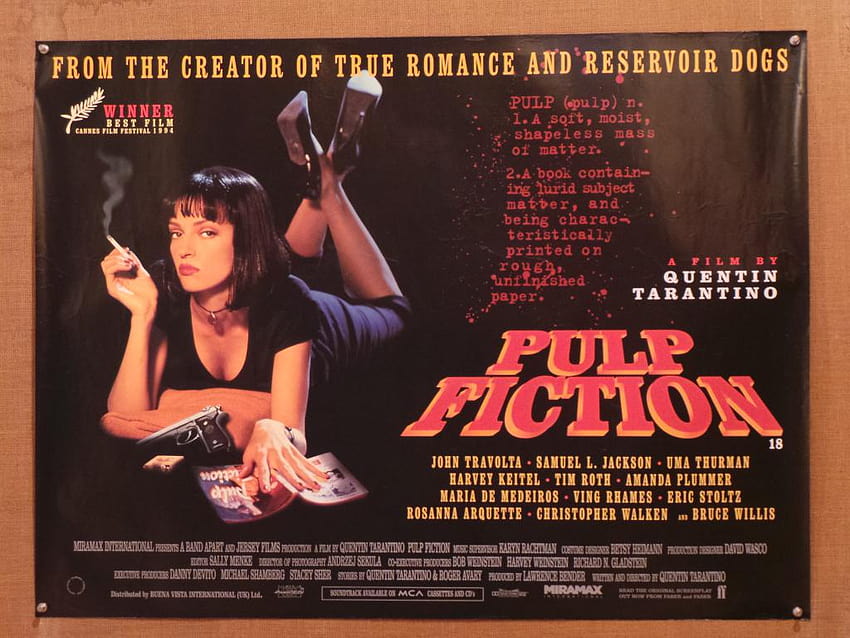
Quentin Tarantino’s 1994 masterpiece that’s equal parts slick, bloody, and downright unhinged. This ain’t your typical crime flick—it’s a jagged, nonlinear ride through LA’s underbelly, packed with sharp dialogue, unforgettable characters, and a vibe that’s as cool as it is chaotic. It’s the kind of movie that grabs you by the throat and doesn’t let go, even when it’s laughing in your face.
I knew of Pulp Fiction’s existence for decades before I finally watched it last month. I find Tarantino’s movies always tough to get started. And by that, I mean pressing play. Once the reel starts rolling, I’m immediately caught up in the film. Pulp Fiction was no different. I think it is because QT’s movies have outlandish plots that are slightly scary to approach for me. Only after I watched the movie do I now realise how many actors’ careers the movie has kickstarted and set an impossible standard to match through the rest of their illustrious careers.
Uma Thurman lounging about cattily on the cover doesn’t help either.
The film kicks off with Pumpkin and Honey Bunny (Tim Roth and Amanda Plummer) plotting a diner stick-up, setting the tone with lines like, “I’m gonna be like Charles Bronson in The Great Escape, diggin’ tunnels!”—except they’re just small-time crooks with big mouths. From there, the movie splinters into a mess of interconnected stories: Vincent Vega (John Travolta), a hitman with a slick suit and a heroin habit, babysitting his boss’s wife, Mia (Uma Thurman), who deadpans, “I do believe Marsellus Wallace, my husband, your boss, told you to take me out and do whatever I wanted. Now I wanna dance.” Then there’s Jules (Samuel L. Jackson), his Bible-quoting partner, spitting fire with, “The path of the righteous man is beset on all sides by the inequities of the selfish and the tyranny of evil men,” before unloading bullets and existential crises. And don’t forget Butch (Bruce Willis), the washed-up boxer who double-crosses the wrong guy and ends up in a pawn shop nightmare that’s as gritty as a North Carolina breakfast.
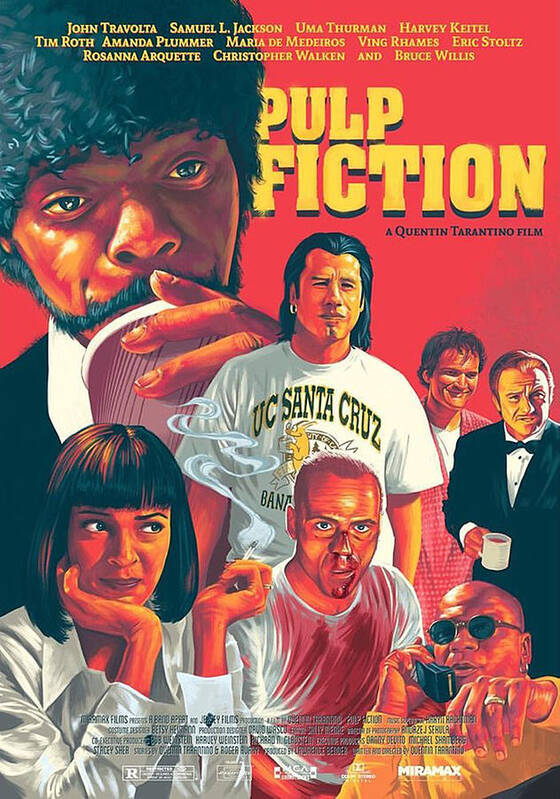
Tarantino’s script is a blasphemous word symphony—every line’s got bite. Take Vincent and Jules debating foot massages: “It’s laying your hands in a manner that’s almost sexual,” Vincent argues, while Jules counters, “It’s not in the same fuckin’ ballpark!” It’s mundane, it’s absurd, and it’s brilliant. The dialogue’s so good you almost forget they’re about to blow some poor bastard’s head off.
Visually, Pulp Fiction is raw and unpolished in all the right ways. The diner’s neon glow, the grimy Jack Rabbit Slim’s, the blood-soaked backseat of a car—it’s a world that feels lived-in, like you can smell the sweat and cigarette smoke. The nonlinear structure keeps you on edge; you’re piecing it together like a puzzle with missing edges, and when it clicks, it’s a gut punch. The adrenaline shot scene? Mia’s OD and Vincent stabbing her in the chest with a syringe while Lance (Eric Stoltz) yells, “You’re givin’ her a shot in the heart, so I guess it’s pretty serious!”—it’s tense, funny, and fucked up all at once.
Flaws? Sure, it’s got ‘em. Some might say it’s too in love with itself, too indulgent with its tangents—like the whole “Royale with Cheese” bit, where Vincent muses, “It’s the little differences. I mean, they got the same shit over there we got here, but it’s just a little different.” It’s iconic, but it ain’t moving the plot. And the violence—graphic as hell—might turn off the squeamish.
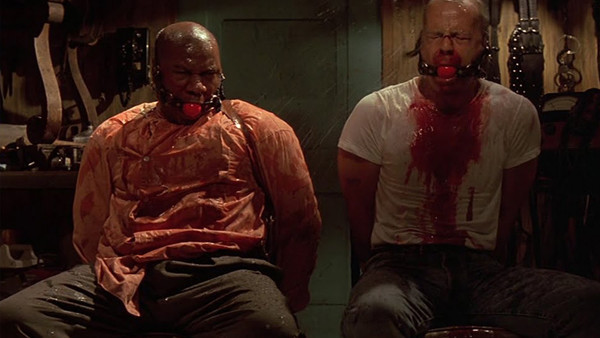
That pawn shop rape scene? Brutal – not for the faint-hearted. Butch Coolidge and Marsellus Wallace end up captured by a pair of sadistic pawnbrokers in a twisted, subterranean nightmare. Locked in a basement, they face a harrowing ordeal involving a gimp, a leather-clad figure, and the threat of unspeakable violence. This dark, gritty sequence is a standout in the film, blending Tarantino’s signature tension, dark humor, and unpredictable storytelling.
Quentin Tarantino’s masterful use of monologues is a defining element, bringing depth and personality to the film’s eclectic characters. One standout is Jules Winnfield (Samuel L. Jackson) reciting a fictionalized Ezekiel 25:17 passage, a chilling and theatrical speech that crescendos before he executes a target, blending menace with philosophical undertones. In a film filled with such over-the-top monologues, the restraint with which Jules delivers his homily and the lines “I’m trying, Ringo. I’m trying real hard to be the shepherd” is the perfect mix of threat, plea, and chastisement.
Still, Pulp Fiction is a stone-cold classic. It’s a middle finger to convention, a love letter to outlaws, and a showcase for Tarantino’s twisted genius. It’s messy, it’s loud, and it’s got more soul than a dozen Hollywood blockbusters combined. As Jules puts it, “I’m tryin’ real hard to be the shepherd.” This movie doesn’t try—it just is. Watch it, soak it in, and good luck getting it out of your head.




 The Reluctant Book Worm
Leave a comment