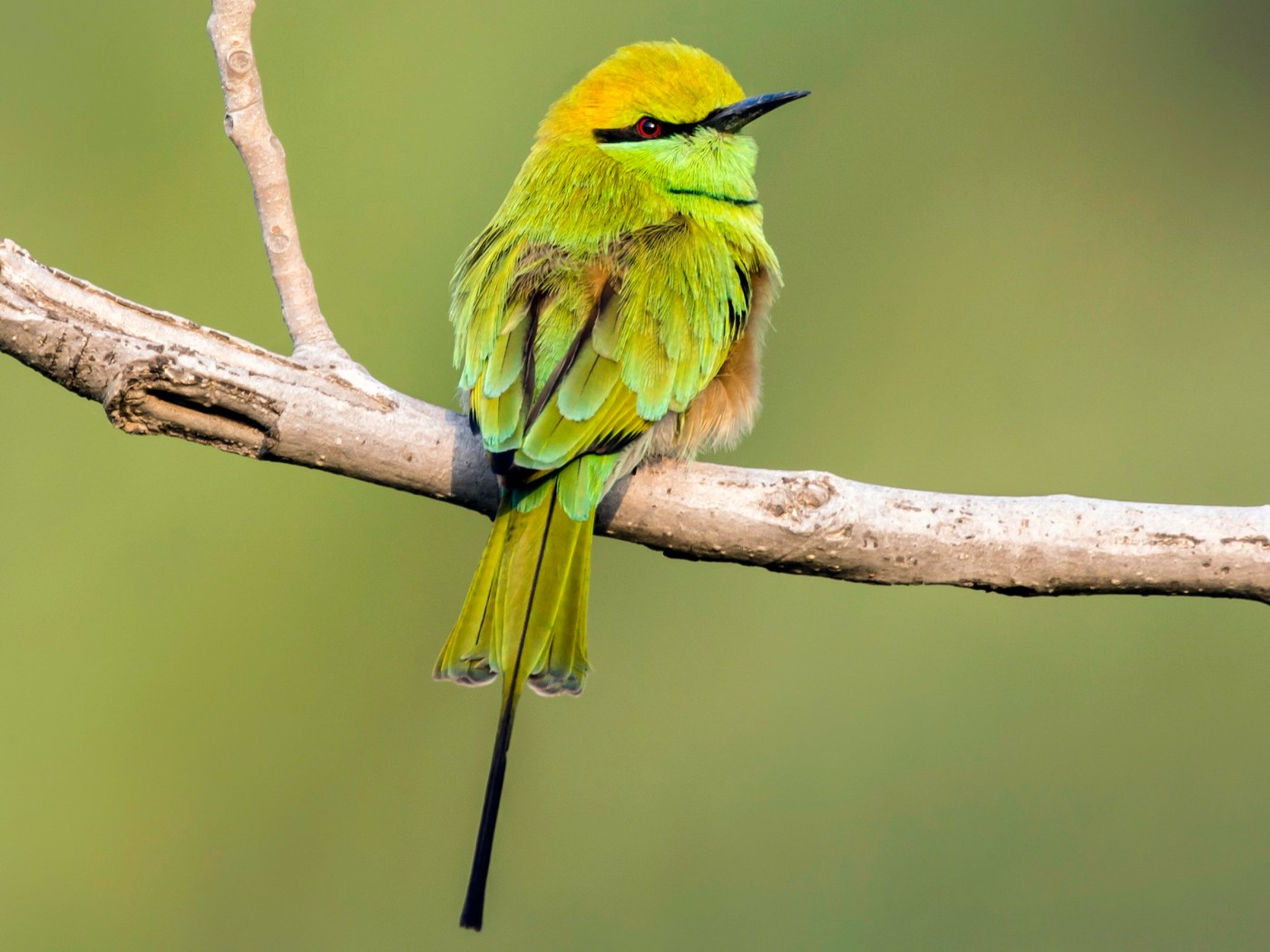
The Asian Green Bee-eater was perched on the tip of a low-hanging branch of the drumstick tree outside my house. It had warmed itself up sufficiently from the overnight chill and looked to be out to hunt. With quick sallies from the perch and purposeful, acrobatic twists and turns, it returns back to its roost from short jaunts with a treat in its beak.
Then begins an orgy of violence.
The bee-eater thrashes the poor insect on the stiff branch, stunning and bludgeoning it, in the process, taking out any sharp stings or defense mechanisms of the prey. Once the bird gobbles the snack, it returns to its watchful state, looking for more flying snacks.

Among humans, beauty sparks violence, as seen in many epics. Helen, in distant Troy, or Sita and Draupadi, closer home, were all deemed too beautiful to exist without being fought over and blood spilled in wars. In the case of the Asian Green Bee-eater, it seems to be the beautiful that indulges in wanton violence.
The Asian Green Bee-eaters (yes, I, too, realize how much of a mouthful the name is, but we’ll persist) are the Cleopatras of birds. Are their makeup to love or kill?
They are the perfect-sized birds if you think an orange is aptly colored and an apple is the right shade of red. Their sharp, pointy beak joins their face and morphs into a sleek black ninja band around their eyes. A dusting of bright cerulean blue in their throat sets the tones for shades used. It’ll have you scrambling for swatch cards. A black band neatly demarcates the blue throat from the fresh green belly that fades into a greenish-yellow-tinged, tapered tail. The tail comes with two characteristic tail streamers.
This is precisely how a masked robber would look if he blundered into a Holi color-powder shop at night, fumbled the light switch, lashed out and rolled about in panic among the wares, and made a desperate dash for it when the crowd forms.


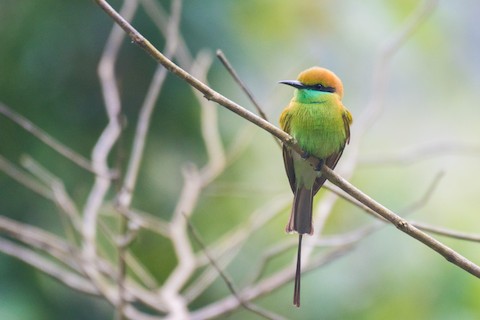
The Asian Green Bee-eater is also clear proof that art and science don’t mix because some scientist looked at all this and decided to name this multi-hued flying dynamo the Asian (yes, duh!) Green (really?) Bee-Eater (sure, why not? Might as well fumble the name all the way).
That is like coming across a Panda in the wild for the first time and naming it “The Asian Black Bamboo Biter.”
A little pardon can be given, though. This is a subspecies of the bee-eater family that, till recently, included the African green bee-eater. That one, if you’ve not already deduced, lives in Africa, has green pigmentation, and eats bees (among other flying nibbles).
The Asian Green Bee-eaters are Merops Orientalis. The African versions are Merops Viridissimus.
Merops comes from ancient Greek for “Bee Eaters.” Hence, they all belong to the Meropidae family of avians. The name Merops is also featured in Greek mythology. I had to look it up as I am out of touch with my Iliads and Odysseys. Merops was the king of Percote, whose two sons fought in the Trojan War against the Achaens and were killed by Diomedes.
Where there is extravagant beauty, bloodlust is inevitable, I guess.
I seek out the AGB-e (I succumbed) in calmer times. Early mornings when the chill hasn’t yet been sucked away by the sun, these gregarious birds huddle together in close groups warming each other up in my neighboring lane. This is how they crank their engines and get their body temperature up after the cold night cools them down. They live in burrows on sandbanks, but I have never encountered the burrows, nor am I confident I can recognize them if I ever do.
In Malayalam, these birds are called Naattu Veli Thaththa, and in Tamil, Pachai Panjuruttaan. The names are evocative and, in many ways, a throwback to when names were just descriptive and a label to refer to simple occurrences. The scientific taxonomy that currently dominates Animalia classification is rigorous and rational, forcing us to look beyond the dazzle of the birds and slot them into categories with biomathematical precision.
The bee-eaters don’t care much for these debates. Why would these wonderfully garish birds worry about unimaginative scientists’ quibbles? How can we look them in the eye when we have named another subspecies, the … wait for it…. Arabian Green Bee-eater?




 The Reluctant Book Worm
Leave a comment