
We’ve had the best bird sightings on Sunday mornings. Today, we saw a flock of rose-ringed parakeets weaving furiously between canopies. These candy-colored fliers are no dandies. They seem to rocket through the leafy lanes with speed, precision, and power. We heard a few white-cheeked barbets before we spotted them hopping around in extra thick foliage. Asian green bee-eaters were bunched on powerlines, waiting for the sun to warm them up before attacking the gnats and bees buzzing around happily.
I even spotted what I think was a purple sunbird boldly squeaking from the top of a tree next to our resident Drongo’s powerline and called out to Mira. By the time Mira had understood what I was saying, parked her bike, reparked her bike (“because it looks like it is about to fall”), transferred the flowers she’d gathered from one hand to the other, and slowly made her way to squint to where I was pointing, the sunbird had been chased away by the Drongo.
I’m really starting to question if the Drongo was not the resident thug around.
We even spotted a tennis-ball-yellow parakeet sunning itself solitarily on a wildly swaying branch for the longest time.
However, the morning’s highlight was the bird I watched from my kitchen earlier. The Greater Coucal.
The greater coucal was walking among the dry leaves under the guava tree behind the kitchen. On second thoughts, the best sighting is always the guava tree. The guava tree is a force of nature, with a canopy that provides such cool shade to our backyard; bountiful, with overripe guavas fully covering the ground and birds, animals, and humans always hovering around to pluck the juicy guavas and not let them go to waste. Thankfully, for the past 10 years, the tree always bears more fruits than all its thankful patrons can consume.
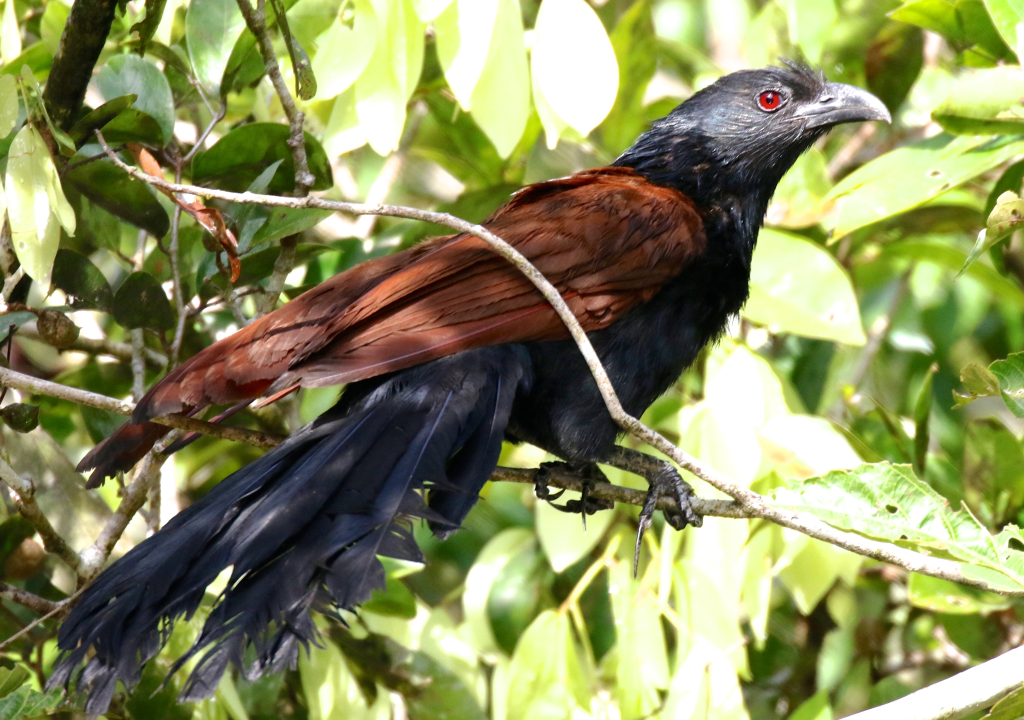
Early in the morning, I had come to drink some cold water and watch the guava tree when I spotted the GeeCee. He was walking about, tailfeathers bouncing one way and then the other, jaunty but not in a hurry, looking as calmly evil as an Indian cop on his way to drink tea on his break from a roadside tea shop.
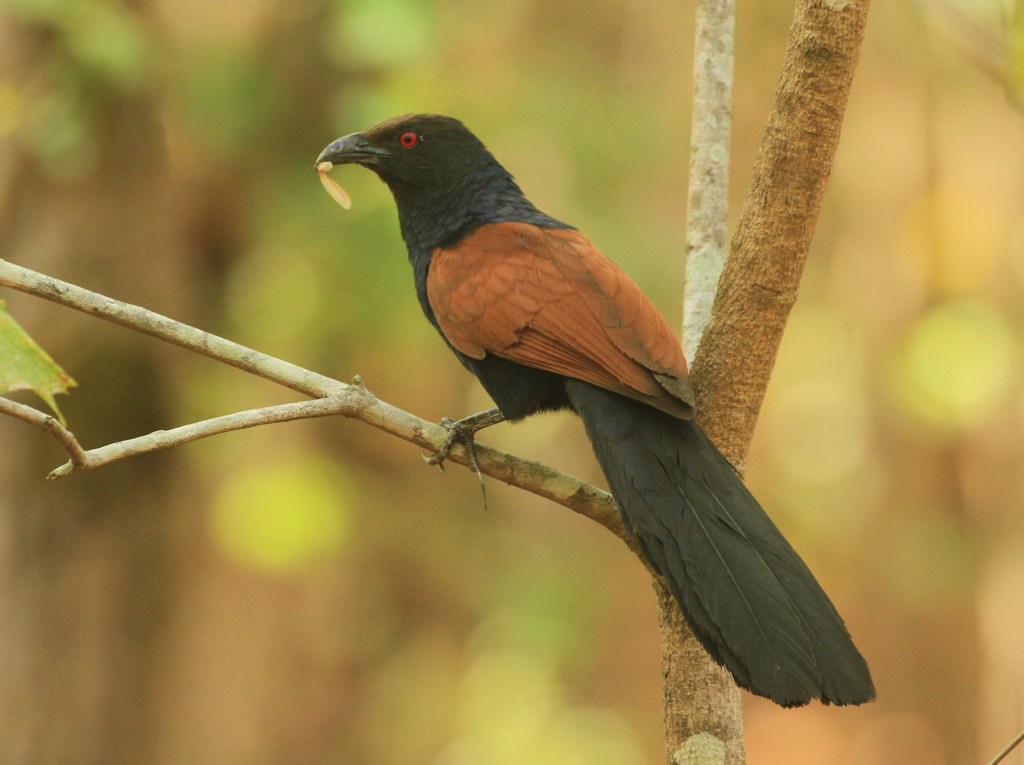
The greater coucals have just a few colors they proudly wear: strong, glossy black feathers with a distinctive Cinnamon Orange back. The adult birds add to the menace with a crimson eye, which is especially conspicuous, given the dark background of its head. They have a corvine appearance. They look intelligent and have curved, strong beaks. They are, however, part of the Cuculidae family. They went by the bridging nomenclature of crow-pheasant, which I think is an absolute banger of a name that pays homage to its appearance but completely misses the biological taxonomy.
Growing up, I remember these birds perched atop tall trees, booming their resonant calls associated with all kinds of omens. They are called Uppan or Chemboth in Malayalam and Shenbagam in Tamil. While researching this bird, someone claimed that the Shenbagam is the national bird of Srilankan Tamils. Curious to learn more, I looked up the national bird of Sri Lanka. It is the Jungle Fowl. A battle of the commoners!
Recently, we visited our in-laws’ farm near the Nagarhole forests. I saw a pair of Greater Coucals jumping from coconut tree to coconut tree. I put on my boots and braved the snake-infested grass to examine the pair closely. As I got closer, out shot a big coucal but with spots. A juvenile. It was not much of an escape, given that it only flew into the neighboring tree and crouched there.
These birds are apparently weak fliers. For all their dark drape, long feathers, and booming calls, they are hoppers, strutters, and jumpers—all walkers and no fliers. It’s a good thing they look like they mean business (and they do in many ways, eating small animals, spiders, and vipers with their claw-like feet), but they can’t fly well.
Ironically, despite all the bad omens they seemingly portend, the sonorous booms, and their adventurous diet, they are among the few Cuculidaes who do not practice brood parasite behavior.
They are just misunderstood birds with a lousy PR rep. Or is that what they are playing at? I can’t read his expression as the Greater Coucal stares me right back into my eyes from under the guava tree.



 The Reluctant Book Worm