
The Purple-Rumped sunbird (Leptocoma zeylonica), along with the Asian Green Bee-Eater (Merops orientalis), is one of the most colorful birds I encounter at home. When the pomegranate plant that grows on my balcony or the shampoo ginger (pine cone ginger) flowers, these sunbirds arrive early to beat the usual queue.
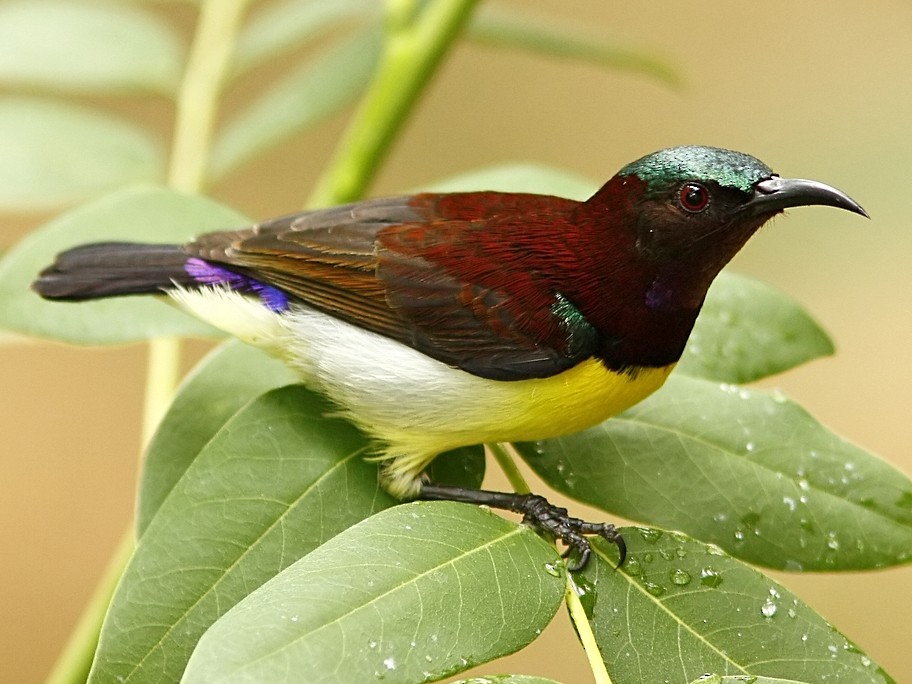
Up close, the Purple-Rumped sunbird shimmers and shines iridescently. The males have a metallic green helmet and shoulder pads, crimson eyes, a most delicious lemon curd of a chest, a reddish-brown back, and a purple rump. Even on the most overcast day, the Purple-Rumped sunbird appears ridiculously colored. Catch sight of them on a sunny day unawares, and you’ll be forgiven for thinking these were rare jeweled birds.
I have grown to appreciate the more sober colors of the female sunbird equally. They have a grey back with a pronounced yellow chest. Together, the male and female pair play a good color foil to one another. For a long time, this sexual dimorphism used to confuse me till my small brain started tuning into nature’s rules.

The name Leptocoma combines the Ancient Greek words leptons, “delicate” or “fine,” and komē, “hair.” I suspect Zeylonica is derived from Ceylon and is a throwback to European white scientists’ orientalisation of the natural world.
Though I only started noticing them recently, I can now identify the Purple-Rumped Sunbirds’ calls with decent accuracy. When I hear their chirping, I look around quickly and usually spot them flitting among the branches, hopping about with jerky jumps. It is surprising how a bird so colorful can so easily go unnoticed when we don’t look for it.
Given their diet consists mainly of nectar, it is no surprise that their Tamil vernacular name is ஊர்த் தேன்சிட்டு. Looking up these vernacular names is tricky, though. Google sometimes spits out the most unreasonable, least commonly used made-up names. Artificial Intelligence technology claims. Lazy approximations for the masses, say the Leptocoma Zeylonicas. One of the names suggested by Tamil Wikipedia for the Purple-Rumped Sunbird was ஊதாப்பிட்டத் தேன்சிட்டு. Given how removed I am from Tamils who are linguistically close to the bird, there is no easy way to confirm their most-used name. Malayalam seems even more of an enigma. മഞ്ഞത്തേൻകിളി, which loosely translates to “yellow-honey bird”, seems reasonable, only till you start questioning why someone might pick the less distinctive marker to name a riotously colored species.
These sunbirds remind me that travel is not where your eye takes you but where your mind takes you. These little birds are exotic and colorful and are endemic to the southern regions of India, Bangladesh, and Sri Lanka. I see them daily, perched on flowering stalks at impossible angles, a conspicuous passerine glaring at unappreciative passersby, reminding me that nature’s treasure box is equitably distributed across the world.





 The Reluctant Book Worm
Leave a comment